AIM
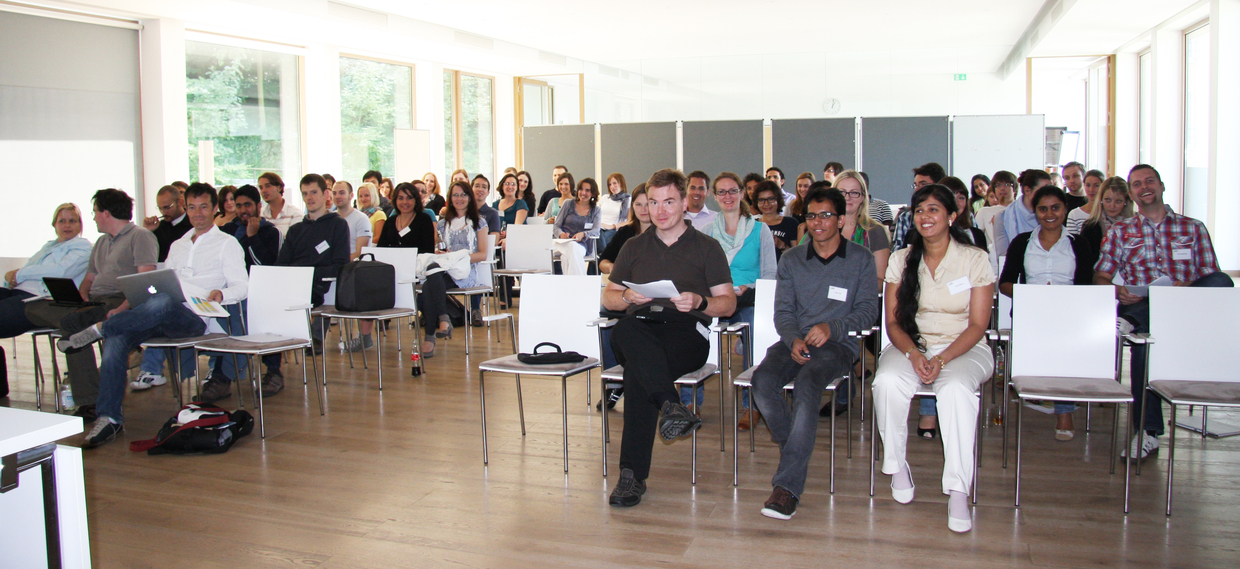
The BioInterfaces International Graduate School offers unique opportunities for students that are interested to work at the interfaces between biology, chemistry, material science, engineering and informatics. Due to the highly interdisciplinary nature of the programs MSE and NACIP, research projects combine state-of-the-art approaches from these major research fields. This gives students the chance to become familiar with diverse experimental approaches and techniques and to combine them through interdisciplinary collaboration with other research groups. Our students benefit greatly from a unique research training that opens new horizons compared to a traditional "monodisciplinary" focused career. This provides the students with special opportunities to use their skills in a rapidly advancing field of complex and interdisciplinary scientific challenges.
The aim of the BioInterfaces International Graduate School is to provide an interdisciplinary environment in which the students are introduced to various major research fields. The BioInterfaces International Graduate School aims to attract outstanding students from around the world. The teaching language is thus English in all courses and lectures. Furthermore, the Karlsruhe Institute of Technology (KIT) and the University of Heidelberg both allow thesis defenses in English. The BioInterfaces International Graduate School has a strong commitment to promote women in science. Thus, female candidates from disciplines where women are still underrepresented are especially welcome to apply.
Participating universities


The BioInterfaces International Graduate School is linked with both the Karlsruhe Institute of Technology (KIT) and the University of Heidelberg . Both universities were selected as one of nine elite universities in the recent ranking of universities in Germany. The University of Karlsruhe has united with the Forschungszentrum Karlsruhe to form the Karlsruhe Institute of Technology (KIT). In addition to offering the right to graduate, both Universities contribute scientifically to the BioInterfaces International Graduate School. While the KIT is more technically oriented, the University of Heidelberg has an emphasis on biomedical research and basic physics of surface interactions and microscopy. The partnership with these two universities thus offers complementary scientific strengths and provides the BioInterfaces International Graduate School with a regional research focus.
These two universities are the main institutions where students graduate. Affiliation of students with other universities are also considered if the graduation of the student is guaranteed at the respective institution under the conditions required by the BioInterfaces International Graduate School (i.e. dissertation in English, PhD thesis work and supervisor at KIT or the University of Heidelberg). The management organization of the BioInterfaces International Graduate School provides the administrative framework for the coordination of the school‘s activities and for optimal support of the students during their PhD. The day-to-day matters concerning the school and students are organized by a manager supported by an administrative assistant.
Participating Institutes
The different Institutes from KIT and the University of Heidelberg participating in the BioInterfaces programme and taking part in the BioInterfaces International Graduate School can be found here.